
About the Fuel Economy Converter
This converts a vehicle's fuel efficiency between the systems used around the world — miles per gallon (US and UK), litres per 100 kilometres, and kilometres per litre. It's the tool for comparing a car's economy figure against a spec sheet in another system, or making sense of a US mpg rating in European L/100km terms.
Need to convert the fuel volume itself, or a trip distance? See the Volume Converter or the Length Converter.
How it works — why it's not a simple factor
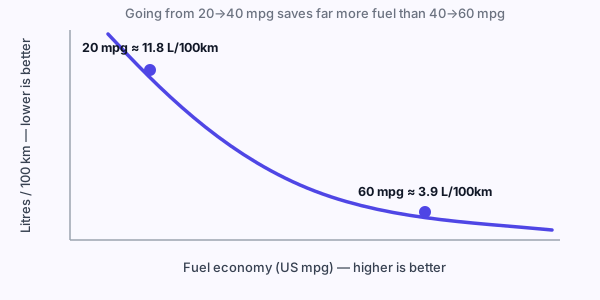
Fuel economy is measured two opposite ways, so the conversion is inverse, not a straight multiplier:
- Distance per fuel — mpg and km/L: higher is better.
- Fuel per distance — L/100km: lower is better.
Because of that, L/100km = 235.215 ÷ mpg(US) (or use 100 ÷ km/L). The reciprocal relationship means the numbers don't scale linearly — improving from 20 to 40 mpg roughly halves your L/100km, but from 40 to 60 mpg saves much less fuel per mile. The tool also distinguishes US mpg from UK (Imperial) mpg, because the two gallons differ.
Assumptions and behaviour
- US mpg and UK mpg are separate. The Imperial gallon is about 20% larger, so the same car reads higher in UK mpg than US mpg.
- The inverse relationship means better economy (more mpg) gives fewer L/100km, and vice versa.
- Results show about 7 significant figures.
- The Swap button reverses the two units.
Limitations
- US mpg ≠ UK mpg — a common source of confusion when comparing cars across markets. Always check which gallon a figure uses; this tool lists both.
- Because the conversion is reciprocal, a value of 0 (or a blank) can't be inverted, so extreme or zero inputs may show a dash or an unhelpful result.
- It converts a stated economy figure; it doesn't calculate economy from distance travelled and fuel used.
- Real-world economy varies with driving conditions — any converted figure is only as accurate as the rating you enter.
Privacy
The conversion runs entirely in your browser. Nothing is uploaded or stored.

 Get FreeMyTask as an app