🇬🇧EN

ASCII / Unicode Converter

Convert text to character code points and back — decimal, hex or U+ notation.

✨ What do you want to try next?

You've finished this tool — here are a few you might find useful.

Explore 100+ free toolsPDF, Image, Text, Convert, Calculate and more — all free.View all tools →

About the ASCII / Unicode Converter

This converts between text and the numeric code points behind each character — ASCII for the basic English set, Unicode for everything else. Developers use it to inspect exactly which characters a string contains (including invisible or look-alike ones), to build escape sequences, to debug encoding issues, or to look up a character's code. Convert text to codes, or a list of codes back into text, in decimal, hexadecimal or U+ notation.

How it works
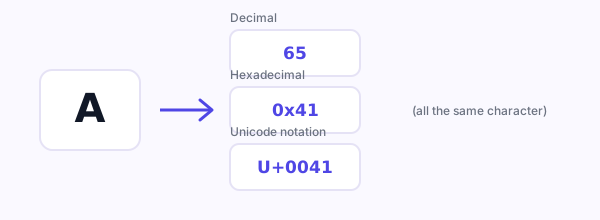
The letter A converting to its character codes: decimal 65, hex 41, and U+0041

Text → codes reads each character's Unicode code point and lists them in your chosen format: decimal (72), hexadecimal (48), or U+ notation (U+0048). It iterates by code point, so emoji and other characters outside the basic range are read as a single value, not split. Codes → text parses a space- or comma-separated list of code points and rebuilds the string. ASCII is simply the first 128 Unicode code points, so plain English text produces the familiar ASCII numbers. Need those hex/decimal numbers converted between other number bases too? Try the Base Converter.

Assumptions and behaviour

  • Uses Unicode code points (codePointAt), so characters beyond the basic plane — including most emoji — count as one code point each.
  • Output format is your choice: decimal, hex, or U+.
  • On decode, code points can be separated by spaces or commas, and accept U+ prefixes or bare hex/decimal.
  • The first 128 code points are exactly the ASCII table.

Limitations

  • Code points aren't UTF-8/UTF-16 bytes. This shows the character's Unicode number, not its encoded byte sequence — a code point above U+FFFF is one number here but takes multiple bytes on disk. Use the Character & Byte Counter for encoded sizes.
  • Grapheme clusters can be several code points. An emoji with a skin-tone modifier, a flag, or a letter with a combining accent is multiple code points, so it converts to multiple numbers even though it looks like one character.
  • Decoding rejects values outside the valid Unicode range (0 to 0x10FFFF).

Privacy

The conversion runs entirely in your browser. Nothing is uploaded or stored.

Frequently asked questions

Is this ASCII/Unicode converter free?

Yes — free, no sign-up, no limits, runs in your browser.

What's the code for the letter A?

Capital A is 65 in decimal (0x41 hex, U+0041). Lower-case a is 97. These are ASCII values, which are the first 128 Unicode code points.

Does it convert Unicode to ASCII and ASCII to Unicode?

Yes, both directions. Paste text to turn each Unicode character into its ASCII/Unicode code number, or paste a list of code numbers to convert them back to text. Since ASCII is the first 128 Unicode code points, plain English characters map straight onto their familiar ASCII values.

Can it handle emoji and non-English characters?

Yes. It reads full Unicode code points, so emoji and non-Latin characters convert to a single code point each rather than being split.

Can I get hex or U+ notation?

Yes. Choose decimal (72), hexadecimal (48) or U+ notation (U+0048) for the output.

Are these the UTF-8 bytes of the character?

No. It shows the Unicode code point (the character's number), not its encoded bytes. A code point above U+FFFF is one number here but several bytes when stored — use a byte counter for encoded sizes.

Why did one emoji produce several numbers?

Some emoji are built from multiple code points (skin-tone modifiers, flags, joined sequences), so they convert to several numbers even though they render as one glyph.

Is my data uploaded?

No. Everything runs locally in your browser; nothing is sent or stored.

Lakshay Kumar

Written by Lakshay Kumar(TechLakshay)

A QA Automation Engineer by trade, Lakshay's real passion is untangling complex problems into simple, working solutions — which is exactly why FreeMyTask exists. On Instagram, he channels that same instinct into helping 26,000+ content creators with SEO education, motivation, and hands-on query solving.

Last updated: September 5, 2026
🎁